AI Image to 3D Reconstruction: Technical Overview
The transition from physical objects to digital 3D models has traditionally been a tedious process. For years, creators relied on photogrammetry—a technique requiring dozens of high-resolution photographs taken from every conceivable angle, processed through heavy desktop software to align overlapping pixels. While highly accurate, photogrammetry fails under suboptimal lighting, struggles with reflective materials, and leaves behind messy, unoptimized point clouds that require hours of manual CAD cleanup.
The Rise of Single-Image Neural Reconstruction
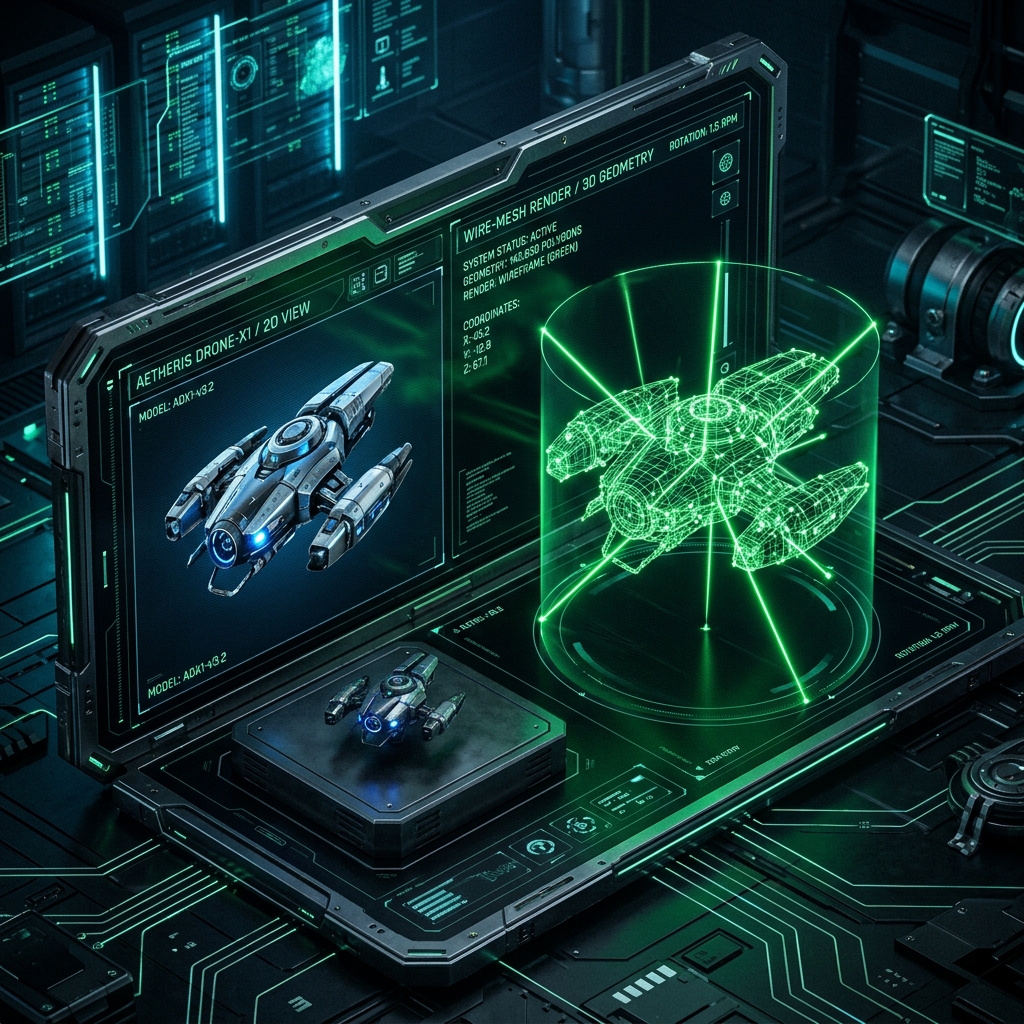
Modern generative AI models have flipped this script. By training deep neural networks on vast databases of synthetic and real-world 3D objects, developers have created feed-forward AI models. Instead of matching pixels between images, these neural networks 'hallucinate' the missing sides of an object based on prior knowledge of shape symmetry, light shading, and depth cues. With a single photo, the AI predicts the volumetric boundary of the subject, creating a rough 3D shape in seconds.
Neural Radiance Fields (NeRF) vs. 3D Gaussian Splatting
Once the AI understands the rough shape, it uses advanced reconstruction pipelines to finalize the visual detail. Two main technologies dominate this space:
Volumetric Technologies Comparison
- Neural Radiance Fields (NeRF): NeRFs represent a 3D scene by training a multi-layer perceptron (MLP) to output color and volume density for any given coordinate. It excels at capturing complex light reflections, but converting this mathematical density field into a solid mesh is slow and computationally intensive.
- 3D Gaussian Splatting: A newer approach that represents geometries using millions of transparent, colored ellipsoids (splats) projected in space. Splatting renders in real-time (over 100 FPS) and allows for much faster, cleaner extractions of solid mesh boundaries.
From Triangle Soup to Print-Ready Quad Mesh
The direct output of a neural network or a Gaussian Splat is usually a chaotic, unoptimized mesh consisting of millions of overlapping, self-intersecting triangles (often called 'triangle soup'). Slicers and game engines cannot use these files directly. This is where Voxelvia3D's post-processing pipeline steps in:
Post-Processing Pipelines
- Quad Retopology: Converting the unorganized triangles into structured, clean quad loops that follow the natural curvature of the shape, preserving edge flow.
- Watertight Seal: Running geometric algorithms to detect and close open boundaries, ensuring there are no micro-holes in the mesh.
- Manifold Repair: Resolving non-manifold edges (where more than two faces share a single edge) to make the model sliceable.
By automating these geometric cleanups on our serverless processing layers, Voxelvia3D delivers files that you can import straight into your slicer or game editor without manual cleaning. You can test this in real-time with our core AI image to 3D generator for digital artwork, or use our photo to 3D converter for real-world objects. Wondering if your subject needs more than one photo? Read our guide on whether you need multiple photos for an AI 3D model. This automated pipeline also powers specialized production workflows like our 2D character to 3D model generator for collectible quad meshes and our photo to 3D relief converter for sculpted commemorative plaques.